

The method in five steps
Add up confirmed money
Savings you will set aside, what you can save each month until the wedding and contributions that family members have confirmed with an amount and a date.
Hold back a contingency
Put a margin for unexpected costs on its own line. What remains is your working budget.
Split fixed and per-guest costs
Estimate the costs that do not change with the guest count, then the cost of each extra guest. Divide what is left after fixed costs by the per-guest cost.
Allocate by priority
Give each category a budget line, putting more money into the two or three things you both care about most.
Track every booking
After each contract, compare the signed amount with its budget line and record the deposit, the next payment and its due date.
Agree on one total before you visit venues
Write down only money you can count on: savings you are prepared to use, a realistic monthly amount multiplied by the months left, and family contributions that someone has confirmed with a figure and a date. Ask early whether a contribution comes with expectations about the guest list or a particular tradition, and agree on that before booking anything.
Keep a margin for unforeseen costs on a separate line. France’s National Consumer Institute, writing with the Banque de France, recommends setting a global maximum, keeping a margin and requesting quotes for each item. The example in this article holds back 10%, which is a choice for the example rather than a rule.
Invented example: €9,000 of savings + €400 a month for 15 months (€6,000) + €5,000 confirmed by family = €20,000. Holding back €2,000 leaves a working budget of €18,000. Every later calculation uses the €18,000; the €2,000 stays untouched until something genuinely unexpected happens.

INC with the Banque de France: planning a wedding budget (19 September 2025; French) · Read on
Work out how many guests the budget covers
Some costs stay the same whether 60 or 120 people come: usually the photographer, music, your outfits, the officiant and the rings. Others grow with every guest: food, drinks, chair and table rentals, cake, stationery and favours. The Knot’s cost guide makes the same distinction, noting that a DJ or photographer usually costs the same for different guest counts while caterers and rental companies do not.
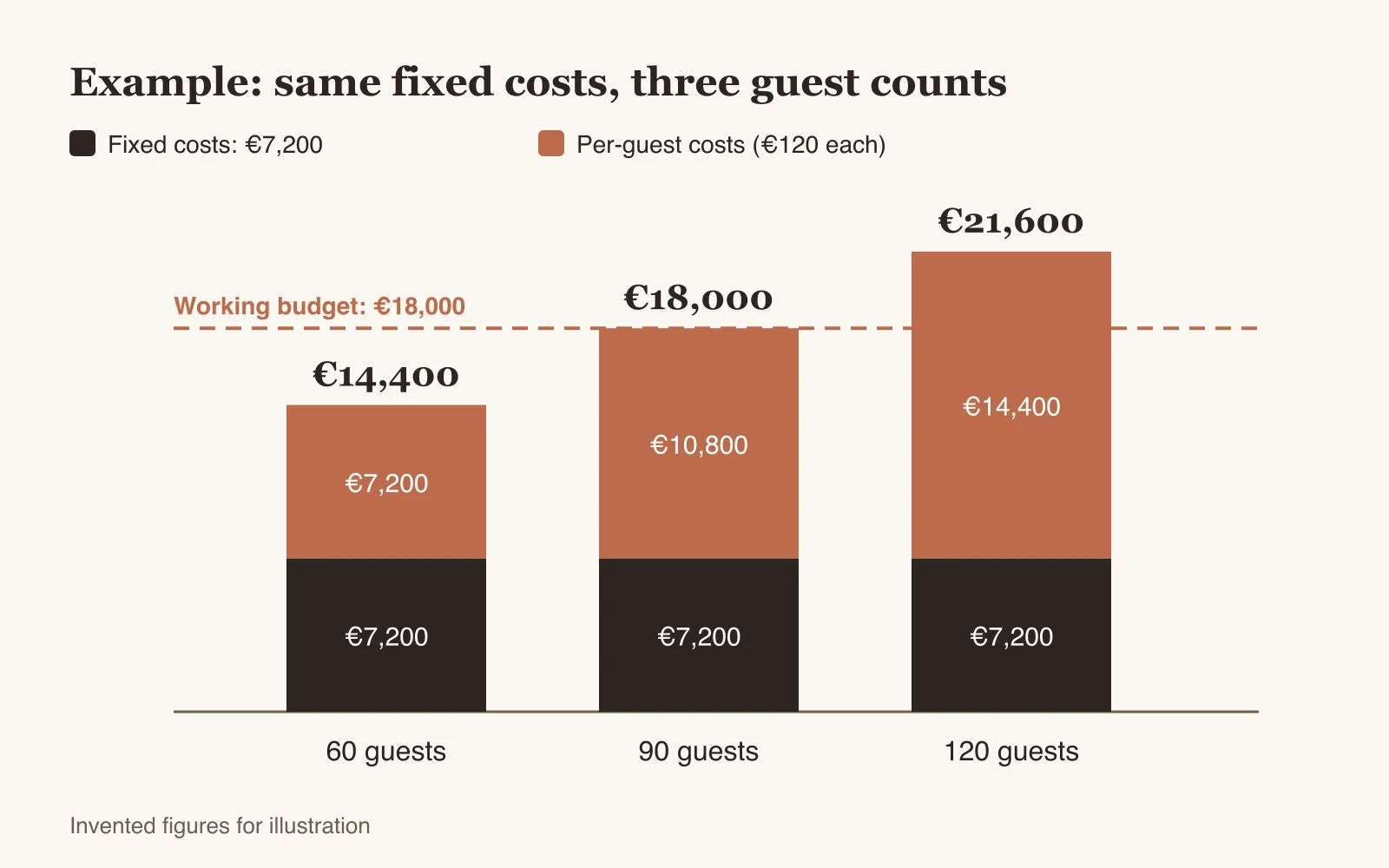
Formula to copy: guests the budget covers = (working budget − fixed costs) ÷ cost per guest. In the invented example, fixed costs are €7,200 and each guest costs €120 in food, drinks, rentals, cake and stationery. (€18,000 − €7,200) ÷ €120 = 90 guests. At 120 guests the total becomes €21,600, which is €3,600 over and larger than the whole contingency.
Published averages show the same pattern. The Knot 2026 Real Weddings Study, based on 10,474 US couples married in 2025, reports an average of $17,100 for weddings with 1 to 50 guests, $27,200 for 51 to 100 guests and $43,300 above 100 guests. In Europe, the 2026 reports on weddings held in 2025 give an average cost per guest of €225 in Spain (Bodas.net), €215 in France (Mariages.net) and €238 in Italy (Matrimonio.com).
Those per-guest averages are total cost divided by guests, so they already include fixed costs. Use them to sense-check your result, never as a catering price. Your own per-guest figure should come from menus and quotes for your date and region.
Chase late RSVPs before you give the caterer the final number
Bodas.net: Informe del Sector Nupcial 2026 (Spain, couples married in 2025; Spanish) · Read on
Mariages.net: Rapport sur le Secteur Nuptial 2026 (France, couples married in 2025; French) · Read on
Matrimonio.com: wedding budget guide (Italy, updated 4 February 2026; Italian) · Read on
Split the rest by what matters to you both
Each of you writes down the three things you would least like to compromise on, then compare lists. Shared priorities get generous lines; the categories neither of you mentioned get modest ones. Matrimonio.com’s planning guide suggests starting with roughly half of the budget for the venue, catering and cake, then adjusting the remaining categories around it.
Invented example for €18,000 and 90 guests: venue, food and drinks €10,800 (the 90 × €120 from the formula); photography €2,200; music €1,200; outfits, hair and make-up €1,800; flowers and decoration €1,000; stationery, officiant and transport €1,000. If photos matter more to you than flowers, move money between those two lines and keep the total the same.
National averages describe what surveyed couples spent, not what you should spend. The Knot reports an average of $34,200 for US couples married in 2025, and lists the engagement ring, rehearsal dinner and honeymoon outside that figure. Bodas.net reports €25,183 for Spain and Mariages.net €19,293 for France, both without the engagement ring or honeymoon. Matrimonio.com gives about €27,300 for Italy. Decide in advance whether your sheet includes the rings, honeymoon or the day-after gathering, so you compare like with like.
Matrimonio.com: wedding budget guide (Italy, updated 4 February 2026; Italian) · Read on
Bodas.net: Informe del Sector Nupcial 2026 (Spain, couples married in 2025; Spanish) · Read on
Mariages.net: Rapport sur le Secteur Nuptial 2026 (France, couples married in 2025; French) · Read on
Copy this budget sheet
Columns to copy into Excel, Google Sheets or Numbers: Item / Fixed or per guest / Budget / Quote / Contracted amount / What the price includes / Deposit paid and date / Next payment and due date / Still to pay / Paid by / Notes. The INC guidance lists the same essentials for a budget table: planned amounts, due dates, deposits paid and payments made.
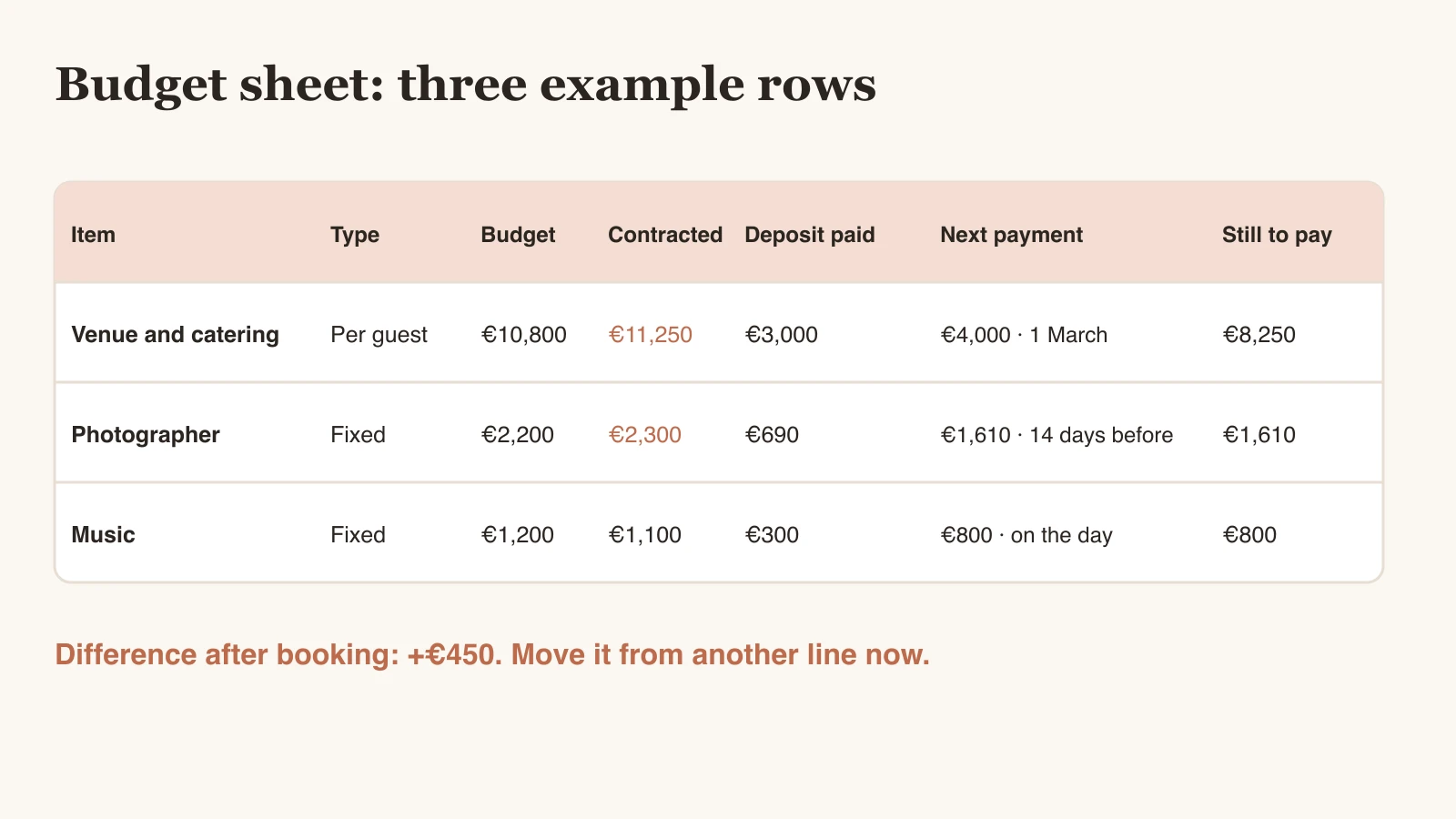
Add two totals at the top: “Contracted so far” and “Budget still unallocated”. Each time you sign, compare the contracted amount with its budget line and move the difference immediately, either from another line or by reducing the guest count. Small differences left for later add up across several contracts.
Invented example rows: the venue and catering quote comes back at €125 per guest instead of €120, so 90 guests cost €11,250 against a €10,800 line. The photographer signs at €2,300 (budget €2,200) and the band at €1,100 (budget €1,200). The net difference is +€450. Trimming flowers and decoration from €1,000 to €550 covers it, and so does removing four guests (4 × €125 = €500).
Compare two venue quotes for the same guest count and hours
INC with the Banque de France: planning a wedding budget (19 September 2025; French) · Read on
Ask about the costs that are easy to miss
Before signing, ask each supplier the same questions and note the answers in the “What the price includes” column: Is tax included? Is there a service charge? What happens to the price if we add guests after signing? What is the hourly rate if the party runs late? Are delivery, setup and collection included? Do staff or musicians need a meal?
Then add lines for items that rarely appear in a venue quote: outfit alterations, hair and make-up trials, postage for invitations, transport for guests, registry or ceremony fees, wedding rings and any customary tips. A line with a small amount is better than a cost you only discover the week of the wedding.
When the total runs over
Overruns are common. Mariages.net reports that only 33% of the French couples married in 2025 that it surveyed kept to their budget and 51% exceeded it. Treat the contingency as the last resort and use this order first.
Start with per-guest costs, because every saving is multiplied by the guest count: a simpler dessert, a shorter drinks list or one fewer course. Next, shorten paid hours, such as the band or the late-night extension. Then move a fixed item down a tier, for example a shorter photography package. Touch the contingency only for costs you could not have predicted, and keep some of it for the final month, when last payments and small extras arrive together.
Optional extras for guests, such as welcome bags or favours, need their own line with a fixed total. In the example there is no spare line for them, so the money would have to come from flowers or stationery. Set the amount before ordering and choose the contents to fit it.
Set a fixed total for optional guest welcome bags
Mariages.net: Rapport sur le Secteur Nuptial 2026 (France, couples married in 2025; French) · Read on
Sources
- The Knot: average wedding cost, 2026 Real Weddings Study (US couples married in 2025; updated 24 June 2026) · Read on
- Bodas.net: Informe del Sector Nupcial 2026 (Spain, couples married in 2025; Spanish) · Read on
- Mariages.net: Rapport sur le Secteur Nuptial 2026 (France, couples married in 2025; French) · Read on
- Matrimonio.com: wedding budget guide (Italy, updated 4 February 2026; Italian) · Read on
- INC with the Banque de France: planning a wedding budget (19 September 2025; French) · Read on
Questions about wedding budgets
How much does a wedding cost on average?+
It depends on the country, region and guest count. Studies of couples married in 2025 report about $34,200 in the US (The Knot), €25,183 in Spain (Bodas.net), €19,293 in France (Mariages.net) and about €27,300 in Italy (Matrimonio.com). These describe surveyed couples; they are neither a minimum nor a target.
What share of a wedding budget goes to the venue and food?+
Usually the largest share. Matrimonio.com suggests starting with roughly half of the budget for the venue, catering and cake. Your actual figure comes from multiplying the per-guest price by your guest count.
How big should the contingency be?+
There is no fixed rule. Pick a margin you are comfortable with and keep it on a separate line; the example in this guide uses 10% of the confirmed money.
When should we start the wedding budget?+
Before visiting venues, because the budget decides how many guests you can invite. The INC guide suggests starting 12 to 18 months ahead so you have time to compare quotes.