

The seating chart in six steps
Count the tables
Divide the confirmed guests by the venue’s maximum per table and round up.
Sort guests into circles
List each guest with their group, meal and any access need.
Seat the top and family tables
Decide where the two of you, the wedding party and your parents sit.
Fill the other tables
Keep groups together and seat the guests left over with people they will talk to.
Place the tables
Put older guests, children and wheelchair users where they need to be on the floor plan.
Make the display and the table sheet
List guests alphabetically with table numbers and send the venue one final sheet.
Count your tables from the floor plan
Ask the venue for a floor plan showing the tables it can fit, their shape and the maximum number of chairs at each. Keep an editable copy, because you will move things around several times. Capacities differ: Matrimonio.com puts round tables at six to twelve guests, and Bodas.net suggests eight to ten per table so conversation flows. Mariages.net recommends at least 60 cm of table edge per guest, more with armchairs, and 1.5 to 2 metres between tables so staff can serve.
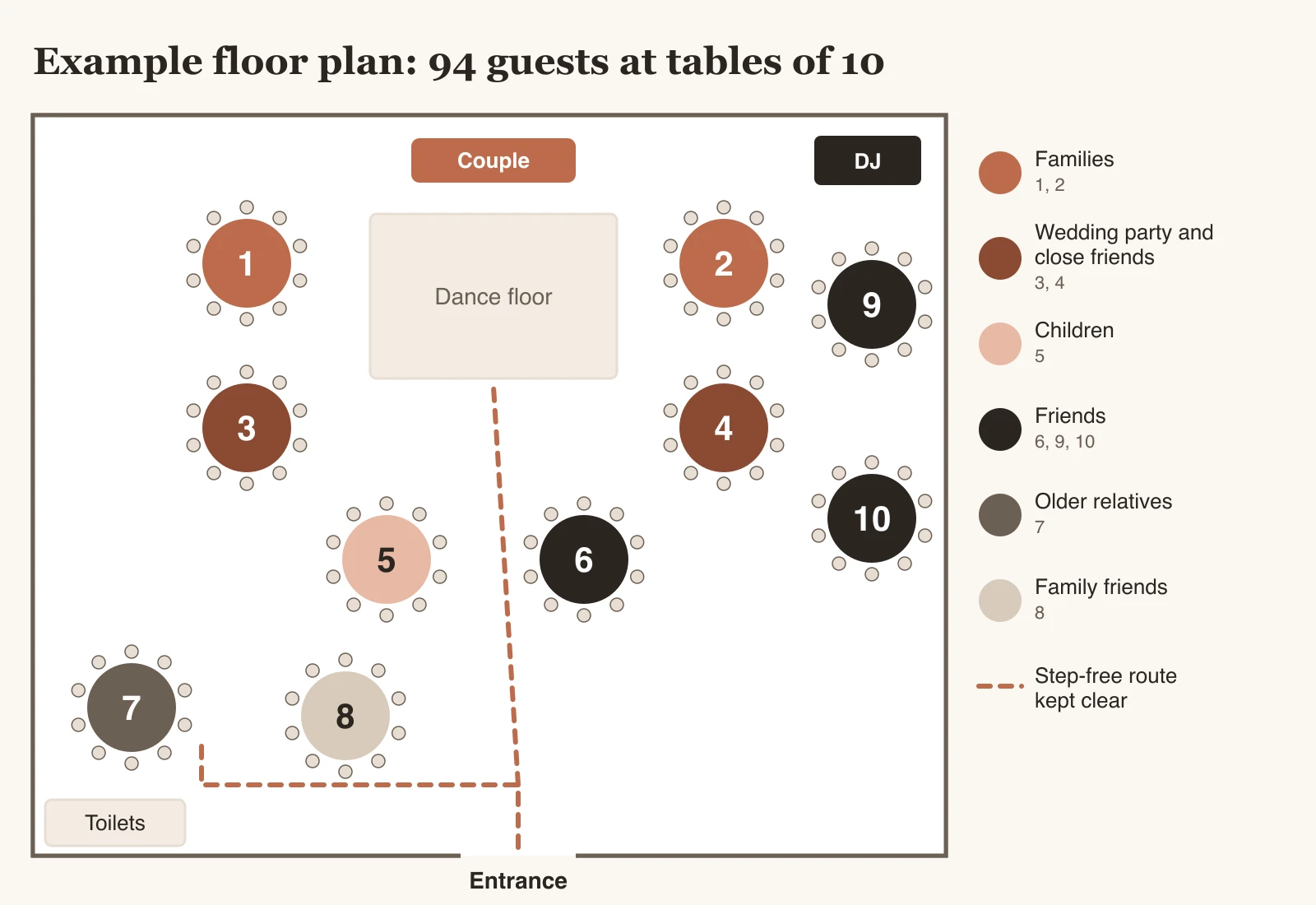
Then divide. Example: 94 confirmed guests at round tables of ten, plus a separate table for the two of you. 94 ÷ 10 = 9.4, so you need 10 tables, which leaves six empty seats for late changes. Matrimonio.com suggests keeping one more table available for last-minute needs; ask the venue whether it can hold one in reserve.
Number the tables on the plan now. Guests will look for these numbers on the day, and the venue staff will use them to serve, so a simple order that runs around the room is easier for everyone than numbers scattered at random.
Matrimonio.com: The complete guide to wedding tables (updated 1 September 2025; Italian) · Read on
Bodas.net: How to organise the wedding tables (updated 2 October 2026; Spanish) · Read on
Mariages.net: How to arrange the tables at a wedding (updated 15 June 2026; French) · Read on
Sort the guest list into circles
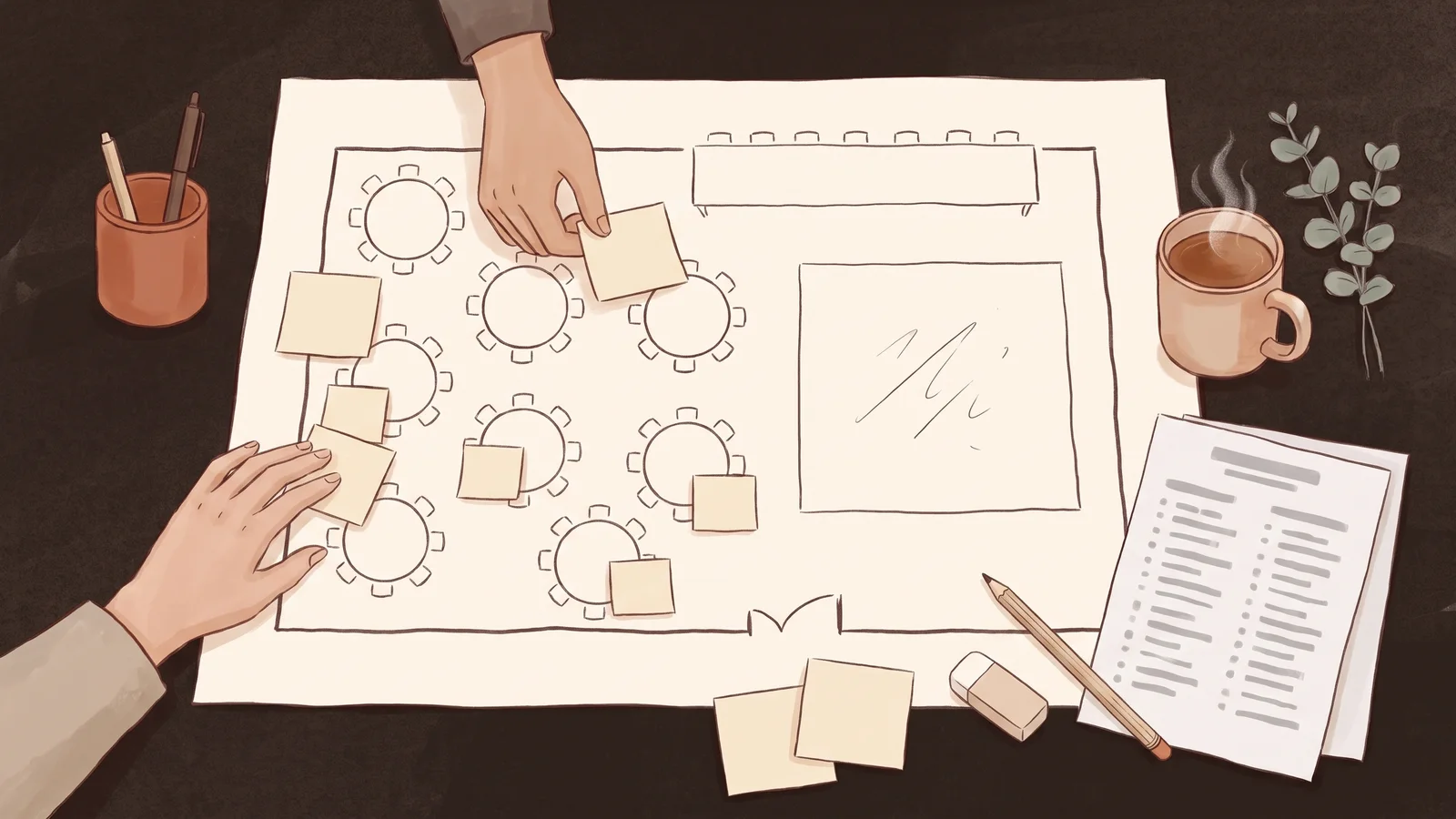
Put the confirmed list in a spreadsheet or on cards, one guest per line: name, whose guest they are, the circle they belong to, meal or dietary notes and any need such as step-free access or a high chair. Circles are the groups people actually spend time in: one side of the family, the other side, school friends, university friends, colleagues, neighbours, your parents’ friends.
The Knot quotes a planner who began grouping guests into tentative tables as soon as the invitations went out, adjusted them as replies arrived and had most of the work done about two months before the wedding. Starting early also leaves time to hear your parents’ requests before a deadline. Bodas.net suggests sorting everyone into categories even if they will not all sit together, because it makes balancing the tables easier.
Leave the guests who don’t fit any circle until later. Once most tables are full, you will see where there is room for them.
The Knot: The lowdown on making a seating arrangement for your wedding (updated 7 January 2026) · Read on
Bodas.net: How to organise the wedding tables (updated 2 October 2026; Spanish) · Read on
Seat the top table and family tables first
Decide where the two of you sit before anyone else. The Knot describes three common choices: a long head table with the wedding party and their partners, a round table at the focal point of the room, or a sweetheart table for just the two of you. It also notes that seating partners at different tables is an old custom now generally ignored. If the head table is short, seat your closest attendants with their partners there and put the rest of the wedding party, with theirs, at a table nearby.
Parents come next. The Knot mentions two layouts: both sets of parents at one large family table with grandparents, the officiant and close friends, or each parent hosting a table with their own relatives and friends. If you don’t know where your parents’ friends should sit, The Knot suggests letting your parents arrange those tables.
Separate tables for each parent often work best when parents are divorced. Agree the arrangement with each of them privately before you place anyone else around them.
Plan separate tables and ceremony seats for divorced parents
The Knot: The lowdown on making a seating arrangement for your wedding (updated 7 January 2026) · Read on
Fill the other tables circle by circle
Seat whole circles together first. The Knot points out that people are most comfortable when they know some of their dinner companions, so keep groups together and mix in only a few new faces. If a group is too big for one table, split it down the middle and fill each half with other guests, and make sure nobody from the group ends up alone somewhere else.
Then place the guests left over. The Knot advises against a singles table and suggests seating single guests with friends or couples they know. A guest who knows nobody will do better next to talkative people or someone with a shared interest. For children, Bodas.net suggests a children’s table when several are over three, with babies and toddlers under three staying with their parents; The Knot adds that a kids’ table should be close to the parents’ tables.
Check each table once it is full: everyone should know at least two people there, couples should sit side by side rather than across a wide centrepiece, and nobody should be next to a person they have fallen out with. If you are unsure about tensions in the family, ask a parent or a close friend before you print anything.
The Knot: The lowdown on making a seating arrangement for your wedding (updated 7 January 2026) · Read on
Bodas.net: How to organise the wedding tables (updated 2 October 2026; Spanish) · Read on
Place the tables where each guest needs to be
Now move the full tables around the floor plan. The Knot recommends keeping older guests away from the music, giving guests who use wheelchairs or have other mobility needs clear access to both the dance floor and the exit, with the chair removed from their place in advance, and putting close family and the wedding party nearest the dance floor for toasts and dances. Bodas.net adds three placements: older guests near the toilets, younger guests near the dance floor and families with prams at the edges of the room, where they won’t block the staff.
In the example plan, table 7 holds older relatives near the toilets and far from the DJ, the children’s table 5 sits beside table 3 where their parents are, and friends sit at tables 6, 9 and 10, the last two closest to the DJ. A step-free route runs from the entrance to table 7 and to the dance floor.
Trace the route from the entrance to every table on the plan, including the way to the toilets and the bar. If a guest uses a wheelchair, ask the venue to keep that path clear when the room is set and to leave their place without a chair.
Ask guests about access needs when they reply to the invitation
The Knot: The lowdown on making a seating arrangement for your wedding (updated 7 January 2026) · Read on
Bodas.net: How to organise the wedding tables (updated 2 October 2026; Spanish) · Read on
Choose how guests will find their seat
Decide whether you are assigning tables only, or tables and seats. Bodas.net describes both options; with assigned seats there is a seating plan at the entrance and a place card at each setting. The Knot separates three items: a seating chart displayed near the entrance with every name and table number, escort cards with each guest’s name and table number, and place cards on the tables when seats are assigned.
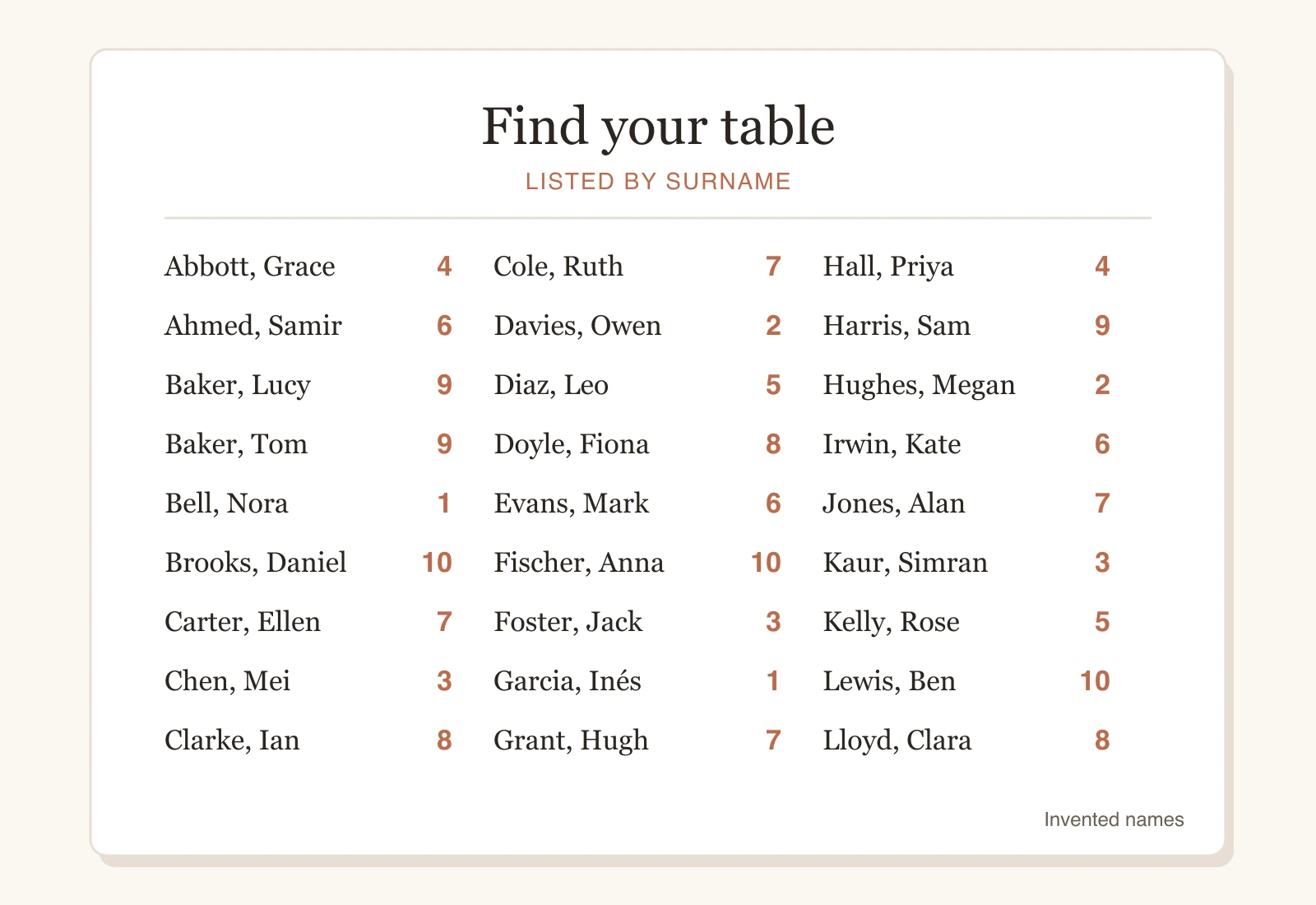
For the display, list guests alphabetically by surname with the table number beside each name. The Knot recommends alphabetical order, especially for large groups, because guests find their name sooner. A list arranged table by table looks tidy but makes people scan every table to find themselves. The Knot describes two common sizes for the display: a canvas about three feet wide resting on a stand on a table, or a floor-standing piece about five feet tall.
Print a full-size proof and read it from two metres away before you order the board. Print the final version last, after the late changes, and give the venue coordinator a spare alphabetical list for guests who ask at the door.
Bodas.net: How to organise the wedding tables (updated 2 October 2026; Spanish) · Read on
The Knot: The lowdown on making a seating arrangement for your wedding (updated 7 January 2026) · Read on
Send the venue one final table sheet
Close the guest list before you lock the plan. Bodas.net recommends calling, rather than messaging, guests who have not replied or gave an unclear answer, at least a month before the wedding. Then send the venue or caterer a single sheet that lists every table, the number of guests at it, children’s meals and dietary needs.
One line per table is enough. Example: “Table 7, older relatives: 9 guests, 1 vegetarian (Ruth Cole), wheelchair place on the side nearest the toilets with no chair.” Keep one master version and change it first whenever something moves, then send the updated file to everyone who needs it.
The Knot warns that however good the plan looks, you will probably get at least one last-minute call asking you to move someone. Agree in advance which of you makes those decisions; The Knot also points out that guests tend to get up and mingle after dinner anyway.
Chase late replies before the guest count is final
Bodas.net: How to organise the wedding tables (updated 2 October 2026; Spanish) · Read on
The Knot: The lowdown on making a seating arrangement for your wedding (updated 7 January 2026) · Read on
Sources
- The Knot: The lowdown on making a seating arrangement for your wedding (updated 7 January 2026) · Read on
- Bodas.net: How to organise the wedding tables (updated 2 October 2026; Spanish) · Read on
- Mariages.net: How to arrange the tables at a wedding (updated 15 June 2026; French) · Read on
- Matrimonio.com: The complete guide to wedding tables (updated 1 September 2025; Italian) · Read on
Questions about wedding seating charts
How many guests should sit at each wedding table?+
Bodas.net suggests eight to ten so conversation flows, and Matrimonio.com gives six to twelve for round tables. Ask the venue for the real maximum at its tables and allow at least 60 cm of table edge per guest, as Mariages.net recommends.
When should we make the wedding seating chart?+
Start grouping guests when the invitations go out and adjust as replies arrive. Finish once the guest list is closed: Bodas.net suggests calling anyone who has not replied at least a month before the wedding.
Do we need a seating chart for a small wedding?+
The Knot calls it a must above about 50 guests and a good idea for smaller events. If you prefer a buffet or cocktail format with free seating, at least reserve places for older guests.
Should the seating chart be alphabetical or by table?+
Alphabetical by surname with the table number beside each name is faster for guests to read, and The Knot recommends it especially for large groups.
Should single guests sit at the same table?+
The Knot advises against a singles table. Seat single guests with friends or couples they already know.