
Writing your vows in five steps
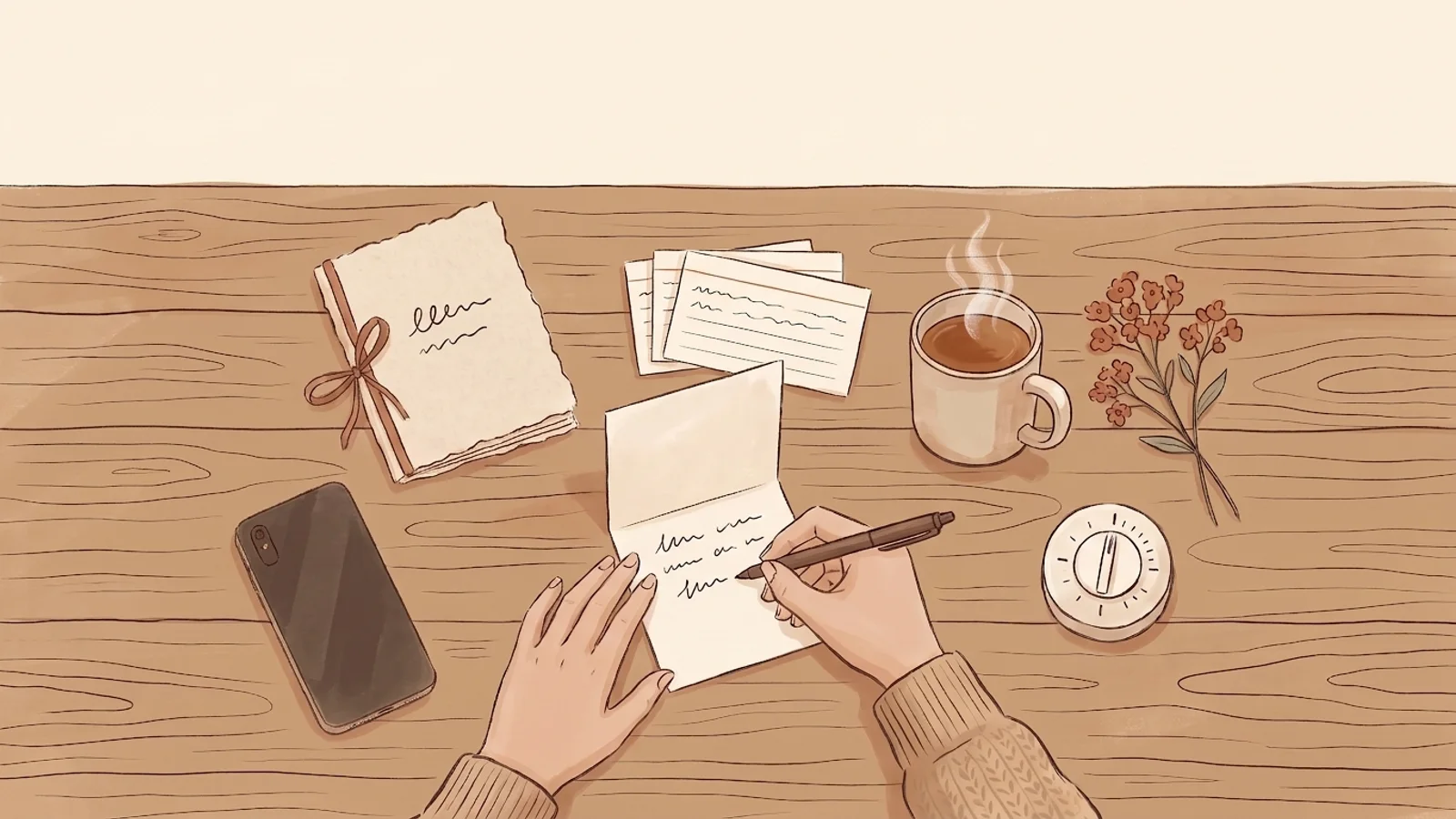
Agree the ground rules
Settle the maximum length, the tone and whether you will hear each other’s vows before the day.
Collect raw material
Spend fifteen minutes answering the prompts in the template below without editing anything.
Fill in the five parts
Choose one story and three or four promises, and write one or two sentences for each part.
Cut to time
Read the draft aloud with a timer and cut until it fits the length you agreed.
Make a reading copy
Print it in large type on a card and give a spare copy to your officiant.
Agree three things with your partner first
Before either of you writes a line, settle the length, the tone and the surprise. Length means a time cap you both respect, such as 90 seconds or two minutes each. Tone means deciding whether you are both aiming for funny, tender or something in between. The Knot advises agreeing on the format first, because one comic set of vows next to one solemn set can make the ceremony feel uneven.
The surprise question is whether you will read each other’s drafts. If you keep the words secret, ask the officiant or a trusted friend to check that both versions match in length and tone. Decide who speaks first as well, so neither of you is guessing in front of the guests.
Then pick a date for a finished draft. The Knot suggests starting about three months before the wedding. Even a short text improves with a few weeks between the first draft and the final version, because cuts are easier to see after a break.
The Knot: How to write your own wedding vows (updated 7 December 2023) · Read on
Use this five-part template
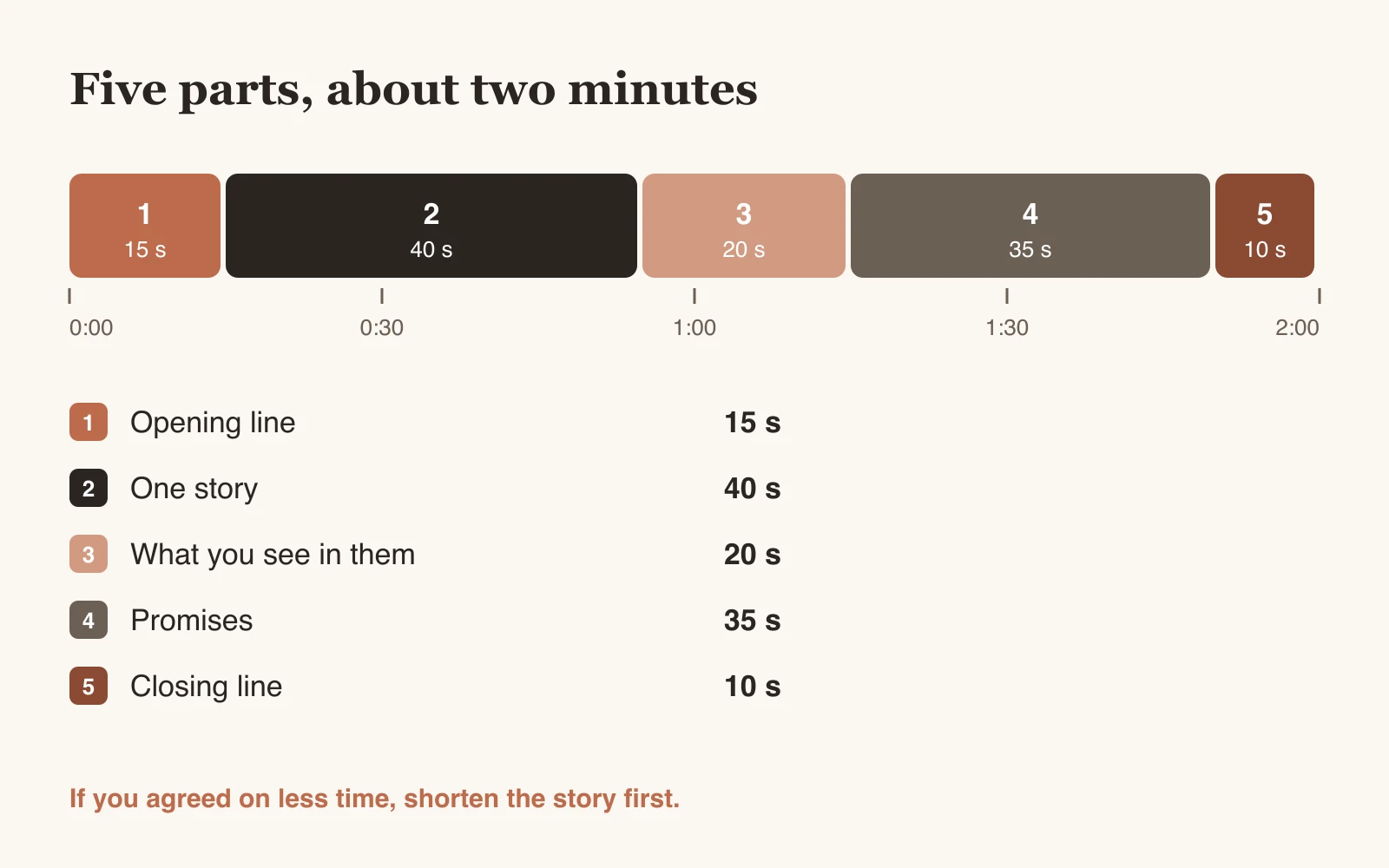
Write one or two sentences for each part, in this order. The time beside each part is its share of a two-minute total; scale everything down if you agreed on less.
1. Opening line, about 15 seconds. Say their name and one thing about this moment or the day you met. Prompt: “[Name], the first time I … I didn’t know that …”
2. One story, about 40 seconds. Pick a single moment that shows who they are and tell it with a few concrete details: where you were, what they did and what you understood. The Knot recommends one or two stories that guests can follow even if they were not there, and few inside jokes.
3. What you see in them, about 20 seconds. Say what the story taught you about them, or what has changed in you since you met. Prompt: “Because of you, I …”
4. Promises, about 35 seconds. Write three or four, mixing everyday promises with one large one. Everyday promises sound like real life together, such as “I promise to make the coffee on Mondays.” The large one is the commitment itself: “I promise to stay on your side when things are hard.” Only promise what you can keep.
5. Closing line, about 10 seconds. Return to the opening image or end with a short sentence you can say while looking up: “[Name], I choose you, today and every ordinary day after it.”
The Knot: How to write your own wedding vows (updated 7 December 2023) · Read on
Keep them to one or two minutes
Guides differ a little on length. Zola puts most vows between 30 seconds and three minutes. The Knot suggests two to three minutes and gives a word count: 250 to 300 words take about two minutes for most people speaking at 125 to 150 words per minute.
A practical target is one to two minutes each, which leaves room in the ceremony for readings, music and the rings. Those word counts are for English, and speaking speed varies from person to person, so the reliable test is a timer. Read the draft aloud at the pace you would use in front of guests, with the pauses, and time it twice.
If it runs long, cut in this order: a second story, any list of adjectives, the explanation in front of a promise and, last, one of the promises. Keep the opening and closing lines, because they frame everything else.
Use the same timing method for a short reception toast
Zola: How long should wedding vows be? (updated 5 February 2024) · Read on
The Knot: How to write your own wedding vows (updated 7 December 2023) · Read on
Two examples to adapt
Both examples are invented. Replace the names, places and habits with your own; the structure is the part to copy.
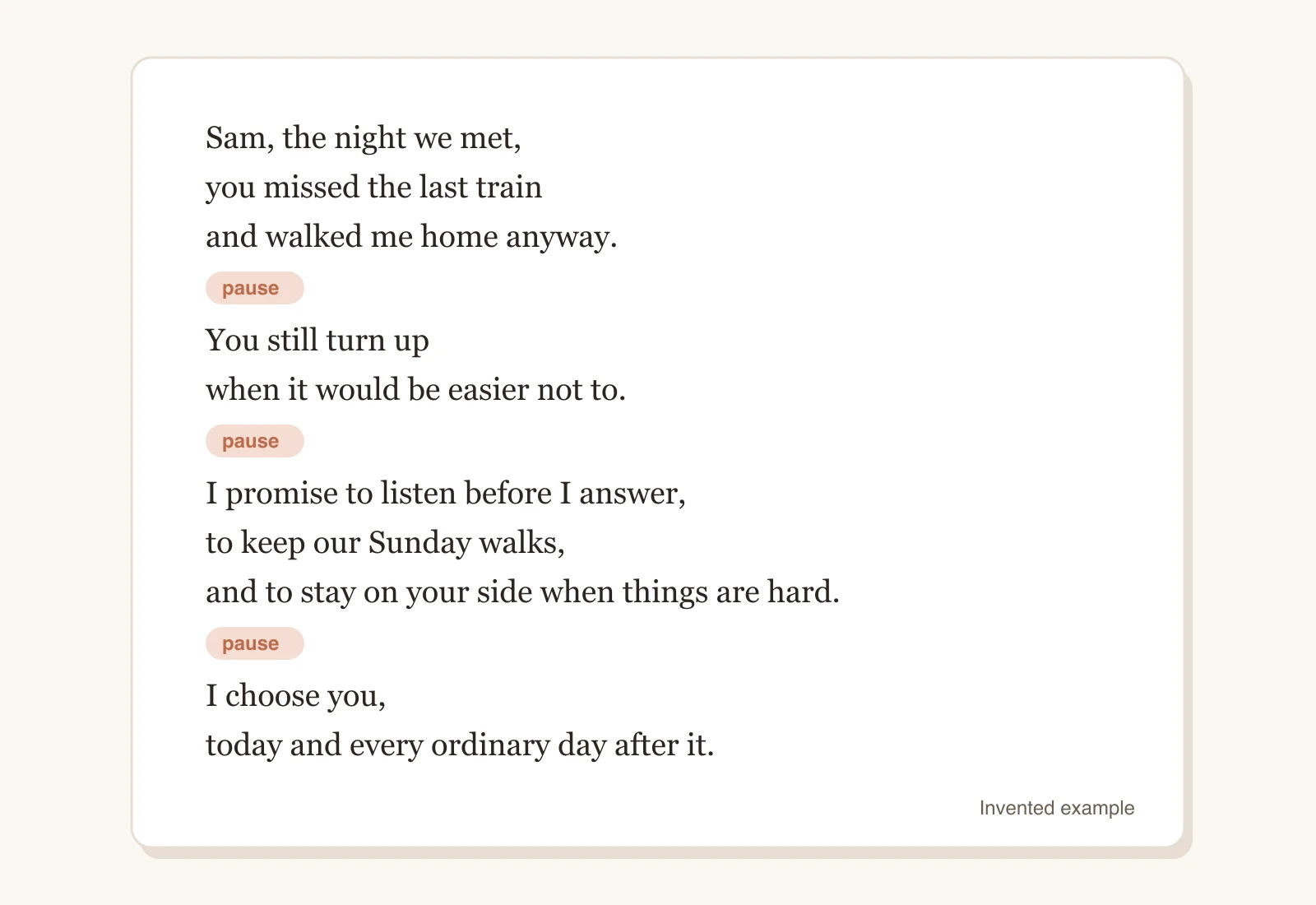
Short version, about 30 to 40 seconds: “Sam, the night we met, you missed the last train and walked me home anyway. You still turn up when it would be easier not to. I promise to listen before I answer, to keep our Sunday walks, and to stay on your side when things are hard. I choose you, today and every ordinary day after it.”
Longer version, a little over a minute: “Alex, four years ago you lent your umbrella to someone you had never met at a bus stop and told me to keep it. I still have it. Last winter, when my dad was in hospital, you drove three hours every Friday, sat in a plastic chair and did the crossword with him so I could sleep. You never mentioned it. That is who you are: you turn up quietly and you stay. Because of you, I have learned to ask for help and to accept it. So here is what I promise. I promise to tell you when I am worried instead of waiting for you to guess. I promise to learn to cook one thing properly. I promise to make room for your family as you have for mine. And I promise to stay beside you on the hard days as well as the good ones. Alex, you can have your umbrella back now. I’m keeping you.”
Notice what the longer version does with the template: the umbrella opens and closes it, the hospital Fridays are the single story, one sentence says what changed, and the promises move from small to large.
Check where personal vows fit in the ceremony
In a civil wedding, the legal part has its own fixed steps. In Spain, Article 58 of the Civil Code has the officiant read Articles 66 to 68 and then ask each of you whether you consent to marry. In France, the City of Paris describes a ceremony of about 20 minutes in which the registrar reads Civil Code articles on spouses’ rights and duties and checks that you want to marry. In Italy, Article 107 of the Civil Code has the registrar read Articles 143, 144 and 147 and receive each partner’s declaration.
Personal vows come on top of that legal wording, so when you book, ask the registry office, town hall or officiant whether there is time for them and how long each of you can speak. Religious ceremonies often have set words of consent as well; ask the celebrant whether personal words fit within the rite or would sit better at another moment.
If there is no room, you can say them at a symbolic ceremony, at the start of the reception or privately before the photos. A symbolic ceremony gives you the most freedom over the order and timing.
See where vows and rings fit in a 25-minute symbolic ceremony
Spain’s Civil Code, Article 58 (BOE consolidated text; Spanish) · Read on
City of Paris: Mariage et Pacs (updated 5 February 2026; French) · Read on
Italy’s Civil Code, Article 107 (Normattiva; Italian) · Read on
Make a reading copy for the day
Print the final version on a card or in a small booklet, in a large font, with one phrase per line and a gap where you want to pause. The Knot recommends reading from a vow book instead of printer paper or a phone. A card also avoids a screen that locks or lights up with a message halfway through a sentence.
Give a spare copy to the officiant or a witness in an envelope with your name on it. If there is a microphone, ask at the rehearsal who will hold it and practise with it once, so your first try is not in front of the guests.
Read the vows aloud three or four times in the last week. Zola suggests practising aloud so you can look at your partner instead of the paper; you do not need to learn them by heart.
The Knot: How to write your own wedding vows (updated 7 December 2023) · Read on
Zola: How long should wedding vows be? (updated 5 February 2024) · Read on
Sources
- The Knot: How to write your own wedding vows (updated 7 December 2023) · Read on
- Zola: How long should wedding vows be? (updated 5 February 2024) · Read on
- Spain’s Civil Code, Article 58 (BOE consolidated text; Spanish) · Read on
- City of Paris: Mariage et Pacs (updated 5 February 2026; French) · Read on
- Italy’s Civil Code, Article 107 (Normattiva; Italian) · Read on
Questions about wedding vows
How long should wedding vows be?+
Most guides land between 30 seconds and three minutes. The Knot suggests 250 to 300 words, which takes about two minutes for most English speakers. Agree a cap with your partner and time your draft aloud.
Should we read each other’s vows before the wedding?+
It is your choice. If you want a surprise, ask the officiant or a friend to read both versions and check that the length and tone match.
Can we say personal vows at a civil ceremony?+
The legal part follows set steps in many countries, including Spain, France and Italy. Ask the registry office or town hall whether personal vows can be added and for how long; otherwise say them at a symbolic ceremony or at the reception.
Do we have to write our own vows?+
No. You can repeat traditional or officiant-provided words, or add a single personal sentence to them. The template works at that size too: one memory and one promise.